Note: Live Chat Do NOT Auto Refresh - You don't need to fill in e-mail / url to chat - Press smilies under Go for more options

radmon.org - Global Radiation Monitoring Live Map


Tracking coronavirus: Map, data and timeline - Click on the dots for more info


Christchurch Quake Map

Japan Quake Map Today


Japan Quake Map Daily Energy Release chart


IRIS Seismic Monitor - Display up to 5000 quakes from an archive of 3.3 million from 1970 to minutes ago

USGS Earthquake List


National Oceanic and Atmospheric Administration's Buoy Map - Tsunami and Ocean Watch In Realtime


Current News Stories


BAD NEWS - BAD NEWS - FUKUSHIMA EXTINCTION LEVEL EVENT


Youtube Video Feeds are currently offline until they fix their feed issues! - Please find the latest Videos by searching for the Usernames below on Youtube directly instead.

Showing posts with label Contaminated Food. Show all posts

Monday, June 14, 2021

Taishan Nuclear Plant Leaking Radiation

A Chinese nuclear power station is leaking radioactive gas and could become a major disaster, according to secret US intelligence reports.

Taishan Nuclear Power Plant, located in southern Guangdong province, is thought to have been leaking for at least two weeks after a French firm that co-owns the facility flagged the issue to Washington.

American agents have spent the last week monitoring the situation and have concluded it has the potential turn into a major disaster but that facility is not currently at 'crisis level'.  

That is in stark contrast to the message being put out by the power plant's Chinese state owners, who insisted in a report published Sunday that everything is 'normal'. 

Taishan Nuclear Power Plant, in southern China, has been leaking radioactive gas for two weeks and is at risk of becoming a disaster, US intelligence agencies have privately warned.Taishan Nuclear Power Plant, in southern China, has been leaking radioactive gas for two weeks and is at risk of becoming a disaster, US intelligence agencies have privately warned


Problems at the power plant first came to light in late May when French firm Framatome reached out to US intelligence agencies to alert them of it, according to documents sent to the Department of Energy and seen by CNN.

A follow-up memo sent on June 3 identified the issue as a 'fission gas leak' and asked for the DoE to share intelligence that might help solve the issue.

Fission gas is a radioactive biproduct of nuclear fission, where heavy atoms are split into lighter ones - a process which releases energy but also creates the waste gas.

Framatome apparently got no response and so sent another memo on June 8 asking for their message to be urgently reviewed.

U.S. assessing ‘leak’ at Chinese nuclear plant https://www.youtube.com/watch?v=q_reUt8HZoA


In that note, they described the problem as 'an imminent radiological threat to the site' and warned that Chinese regulators had increased the 'safe' levels of radioactivity allowed around the plant.

Increasing the 'safe' limit means China has been able to keep the plant running instead of shutting it down to resolve the issue.

Framatome claimed China more-than doubled the limit, and that the new limit exceeds the current safety standards in France.

The French firm which co-owns the plant (file image) warned US officials of the threat two weeks ago while asking for help to fix itThe French firm which co-owns the plant (file image) warned US officials of the threat two weeks ago while asking for help to fix it


The June 8 memo was picked up by the US State Department, setting off a flurry of activity over the last week that included meetings of senior figures on the National Security Council to assess the threat.

They concluded that while the plant could turn into a major disaster, they believe it is not in immediate danger of becoming one and it is more likely the issue will be resolved without seriously endangering the public.

It is not clear from CNN's report whether the intelligence agencies shared the information that Framatome were seeking.

The French firm openly acknowledged the problem on Monday, saying they are working to fix a 'performance issue' at the site.

Meanwhile French energy giant EDF also put out a statement on Monday, saying there has been an increase in noble gases detected in the plant's cooling system.

Noble gases are one of the biproducts of nuclear fission, and their presence in the cooling system may indicate a leak in the reactor.

EDF insisted the presence of noble gases in the cooling system 'is a known phenomenon, studied and provided for in the reactor operating procedures.'

The operator of the power station, state-owned China General Nuclear Power Group, said in a statement on Sunday evening that 'the environmental indicators of Taishan Nuclear Power Plant and its surroundings are normal'.

The French firm which co-owns the plant (file image) warned US officials of the threat two weeks ago while asking for help to fix itThe Chinese state-run firm which owns the nuclear facility insisted in a report published on Sunday that everything is 'normal'


Powered up in 2018, the Taishan plant was the first worldwide to operate a next-generation EPR nuclear reactor, a pressurised water design that has been subject to years of delays in similar European projects in Britain, France and Finland.

EPR reactors have been touted as promising advances in safety and efficiency over conventional reactors while producing less waste.

The plant's state owners said one of the two reactors on site then completed an 'overhaul' and 'successfully connected to the grid on June 10, 2021.'

It did not say why the reactor was overhauled or what exactly had been done to it.

Nuclear plants supplied less than five percent of China's annual electricity needs in 2019, according to the National Energy Administration, but this share is expected to grow as Beijing attempts to become carbon neutral by 2060.

China has 47 nuclear plants with a total generation capacity of 48.75 million kilowatts -- the world's third highest after the United States and France -- and has invested billions of dollars to develop its nuclear energy sector.

Last month Russian President Vladimir Putin and his Chinese counterpart Xi Jinping hailed close ties between their countries as they launched work on Russian-built nuclear power plants in China.

Thursday, April 8, 2021

Fukushima To Dump Contaminated Water Into Pacific Ocean

Tsunami-crippled Fukushima No. 1 nuclear power plant
Prime Minister Yoshihide Suga said Wednesday that the time is ripe to decide the fate of the treated radioactive water stored at the Fukushima No.1 nuclear plant, despite strong opposition from fishermen over its release into the sea.

In a meeting between Suga and Hiroshi Kishi, president of the National Federation of Fisheries Co-operative Associations, the fisheries association chief reiterated concerns over the reputational damage that the discharge into the Pacific Ocean may inflict on fisheries products from Fukushima Prefecture.

After the meeting at the Prime Minister’s Office, Kishi quoted Suga as saying, “The disposal of ALPS treated water is unavoidable and experts have recommended that the release into the sea is the most realistic method that can be implemented. Based on these inputs, I would like to decide the government’s policy.” ALPS refers to the process used to treat the water at the tsunami-stricken plant.

Kishi said fishermen across the nation are still firmly opposed to the plan.

But if the government decides to release the treated water into the ocean, Kishi called on the government to take measures to address reputational damage for the industry and provide ample explanations on its decision — including by discussing safety concerns — to fisherman and the broader public.

Suga’s administration has pledged to make a formal decision on the fate of the accumulating water as soon as possible, given that it will take two years of preparation before it can be released. The plant operator, Tokyo Electric Power Company Holdings Inc., which has accumulated more than 1.2 million tons of treated water, expects to run out of tank storage capacity around the fall of 2022.

Trade minister Hiroshi Kajiyama, who joined the meeting with Kishi and other fisheries officials, said that Suga has asked for their understanding and cooperation for the government’s plan to decide the policy on the treated water.

“What to do with the ALPS treated water is a task that the government can no longer put off without setting a policy,” he told reporters after the meeting.

Media reports say Suga is likely to call a Cabinet meeting on the fate of the treated water as early as next Tuesday, but Kajiyama said no date has been set yet.

The treated water has been building up because more than 100 tons of groundwater seeps into the wrecked reactor basements every day, mixing with highly radioactive debris. Tepco uses the purification system called ALPS that removes dozens of radionuclides to levels in line with national standards but cannot remove tritium.

A Ministry of Economy, Trade and Industry panel in February 2020 recommended that the water be released into the sea, saying that it is a common practice for nuclear plants around the world. Resolving the water issue would pave the way for the plant’s decommissioning to be completed sometime between 2041 and 2051. There has been mounting concern that more than 1,000 storage tanks spread out across the plant would hinder the decommissioning work, including the extraction of nearly 900 tons of melted reactor debris from the three wrecked reactors.

The government is considering releasing water in small quantities at a time into the Pacific off Fukushima Prefecture over a period of about 30 years, after diluting the concentration of tritium to about one-fortieth of the maximum set out by national standards. It says the move is not expected to impact human health.

Still, the public’s support for the discharge remains low. An NHK survey showed last month that 51% of respondents are against the release, compared with 18% who support it.

The plans have also invited stiff criticism from neighboring countries including South Korea. According to Fukushima Prefecture, 15 countries and regions, including China, Hong Kong and Taiwan, still enforce import restrictions on food from the prefecture, though 39 nations have lifted such restrictions in the years following the nuclear disaster.

The government was on the brink of formally approving the release last October but the plan was pushed back after facing strong opposition from local fishermen and the National Federation of Fisheries Co-operative Associations.

Source: (May Need Registration To Read) by Osamu Tsukimori and Satoshi Sugiyama.

Sunday, May 29, 2016

[ART] What's Next Fukushima

Some nice looking art made by paintedtrains displaying tsunamis and the most recent nuclear disasters with the words "What's Next?".

Fukushima Art by paintedtrains
Art by paintedtrains - For more go to Instagram @paintedtrains


paintedtrains on Instagram

Tuesday, April 26, 2016

☢ [PHOTOS] After Chernobyl Rural Life Vanished ☢

30 years after the Chernobyl disaster it's shadow still lies heavy over Belarus. No other country was hit so hard. 70 percent of the radioactive fallout landed there, and one in five residents suddenly found themselves on poisoned land. Entire villages were buried in the ground to prevent people from returning. The disaster destroyed an entire rural culture.

Chernobyl Radiation Warning Sign
Chernobyl Radiation Warning Sign - Photo by Beatrice Lundborg

Anna-Lena Laurén and Beatrice Lundborg
Text and Photo by Anna-Lena Laurén and Beatrice Lundborg
The following text originally written by Journalist Anna-Lena Laurén have been translated from Swedish to English.

It is important to look for the apple trees. Where there's apple trees, there have once been a home.

Buried under the soil, overgrown with hazel bushes and newly planted pines.

The only thing that stands upright in this former village is a silver statue of a Soviet soldier, he stands at attention at the entrance as a kind of absurd symbol of a past buried under last year's dry leaves and pine plantations.
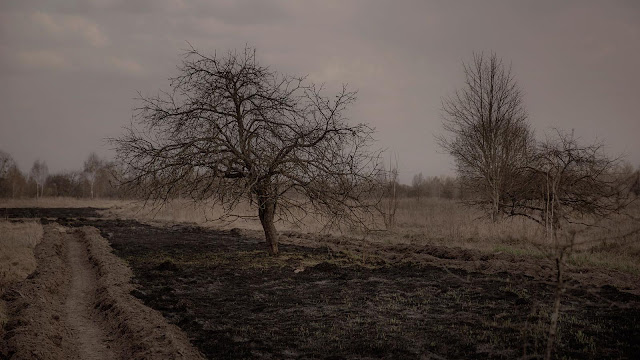
Chernobyl Apple Trees
Chernobyl Apple Trees - Photo by Beatrice Lundborg
Sometimes you find small hills in the countryside. There lies the demolished remains of a house. Or "chutar", as they say in these parts - a Belarus peasant cottage with spacious porch, worn stairs and ornate window frames.

I try to imagine how it once was out here. The cottages, barns, sheds. The sandy village road, which continues to the cemetery a short distance away. The graves are still there and every year villagers from Starinka gather there in early May to celebrate radunitsa, the Orthodox Church holiday when honoring their dead by eating and drinking on the grave yard. Sometimes even dance and sing to. Fistfights also occur. This is a region where the relationship with the ancestors and family's land is concrete and tangible, the ground and the trees are considered to be inspired, to leave them is like leaving a man. Not to speak of burying them.

"I'll tell you how our grandmother said goodbye to our house. She bowed to the barn. She went around and bowed to every apple tree. And when we left our home our grandfather took off his hat."
From: "Pray for Chernobyl" By Svetlana Aleksijevitj

In hundreds of Belarusian villages the farming community survived and remained well into the 1980s, despite the forced collectivization. Many had never left their home and among the elderly, it was still not unusual to not be able to read and write. April 26, 1986 catapulted this archaic society into the atomic age when the Chernobyl nuclear power plant exploded two hundred kilometers to the south.

The wind was blowing to the north and 70 per cent of the radioactive fallout ended up in Belarus, a country with more than ten million inhabitants. Over two million people were exposed to radioactive fallout, over twenty percent of the country's territory were soiled. There was no other country than Belarus that was proportionally hit so hard by the Chernobyl disaster.

In the buried village of Starenka where we now are the measuring instruments, known as a dosimeters, are showing that the dose is 3.2 microsieverts per hour. As a comparison, the Japanese authorities after the Fukushima accident evacuated residents from areas with a radiation higher than 3.8 microsieverts per hour. In Sweden it is considered 0.1 to 0.3 microsieverts per hour to be normal background radiation. In Belarus levels seen at 0.2-0.4 are now normal, according to our local guide.

Starenka located in the so-called "zone", 600-kilometer-wide area affected by radioactive fallout from the Chernobyl disaster. Here on the Belarusian side, where most of the Chernobyl Exclusion Zone is located a total of 70 villages have been buried.

The area is in turn subdivided into several zones. On the map it looks like a patchwork quilt. In the deep red zone, nothing appear at all, the radiation level is too high. In the red zone the levels are so high that no one is recommended stay there, but many have returned. In a third zone, the authorities have declared safe even when the radioactivity is elevated. The authorities say they monitor the situation. The fourth zone is located at the tip and have slightly elevated radioactivity.


South Belarus Towns Deserted
South Belarus Towns Deserted - Photo by Beatrice Lundborg

"During the war, every fourth Belarusian died, today every fifth now live on contaminated land."
From: "Pray for Chernobyl" By Svetlana Aleksijevitj

Shortly after the disaster, thousands of evacuated people chose to move back to the zone. They simply could not stand to not live in their own homes and villages. One of those who from the beginning refused to move is 63-year-old Nina Perevalova that we found in the abandoned village of Dubna. Like many other older people who have chosen to stay in the empty villages, she believes that the evacuation was unnecessary.
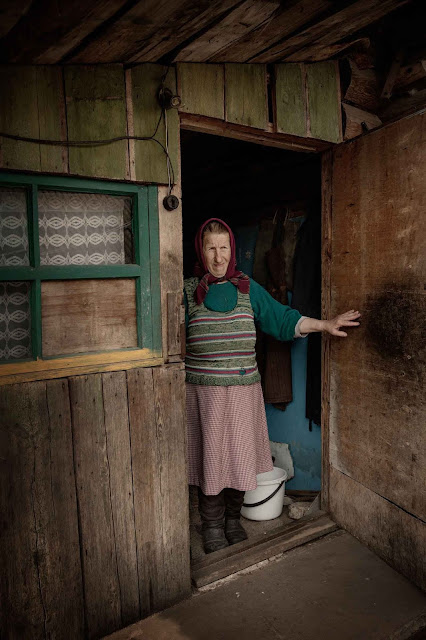
Nina Perevalova
Nina Perevalova - Photo by Beatrice Lundborg

Everyone that left these parts have died. They were promised compensation and went away. They saw it as an opportunity to make money. But they were not happy in their new home and now most of them are dead. We who stayed are still alive on the other hand.

Nina Perevalova goes back and forth between the cabin and the hen house, cattle shed and pigsty. She's practically wearing galoshes, woolen sweater and a green jacket. Red plaid skirt, purple scarf on the head. Actually, she has no time to talk to us, she has chores to attend to and sticks hear head into the cabin and commands her husband to come outside.

Nina Perevalova
Nina Perevalova Photo by Beatrice Lundborg

Kolja! Come out, we've got guests!

Mykola Nikitenko, 58, an unemployed tractor driver. Sometimes he works as a day laborer on construction sites, otherwise he lives off the garden, his pets and his wife's pension. He does not regret the decision to stay, even though they have been left alone in the village.

Here lived some fifty families before the disaster. We had a private shop and nearby there was a collective farm where a large part of the inhabitants worked. Over there was a road... and that's where one of his neighbors had his garden, Nikitenko said, pointing to an overgrown field.
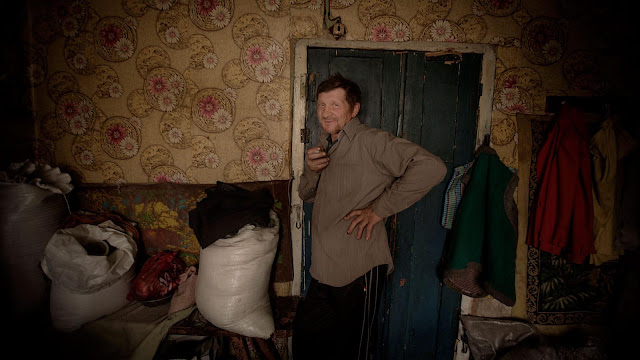
Mykola Nikitenko
Mykola Nikitenko - Photo by Beatrice Lundborg
Of fifty households there remains only three. Four, five buildings remain, the rest ageing slowly but surely. Houses leaning and gray are the remains on both sides of the village road, they resemble old people who rely on a cane. The logs are gray with age, many houses have no roofs. Others have already fallen over and lies helpless on the ground, eventually becoming the piles of boards where people provide themselves with firewood.

The remaining houses have tin roofs that often goes almost to the ground. They look ancient, part of the landscape, brown and gray with beautiful, ornate window frames painted in bright green or sky blue. Nina Perevalovas and Mykola Nikitenkos house is simple, run-down and poor but impeccably well maintained - from the house to the roost to the pigsty and the sheep house is neat and tidy, everything has its place.

Birdsong sounds everywhere and hazel thicket have small green leaves. Up in a telephone pole there are birds. It is now spring, intense spring. Around one of the fallen houses small white and gray kids are leaping up and down of what is left of the timber wall. Nina Perevalova speak with them. She talks constantly with all their animals and calling them by name - pig named Vaska, the fearless gray hen Sivka and favorite price Gorka.

Fallen Houses
Fallen Houses - Photo by Beatrice Lundborg

This is my baby. Gorka, my little man .... Gorka my golden boy, says Nina Perevalova and scratches a kid area behind the ear.

Then she looks up.
 
I drink goat milk, gathering berries and mushrooms in the forest, growing in the kitchen garden. We have pigs and chickens. We are doing well. Only sore legs. Maybe it has to do with Chernobyl, what do I know? Everything was better and everyone was happier when we did not know anything about this radiation!

She invites us in the hall and pours fresh goat milk in a tin mug. I drink a sip, it tastes good. Then I set the cup back on the table. Our instruments have shown the normal radiation levels in this village, but I can not bring myself to drink up. After reading about how tired these villagers are and other precautions I feel ashamed before Nina Perevalova, but she says nothing. By all accounts, she is accustomed.

When they last came here and measured how much radiation we have in the body, I had exceeded the norm. My husband had however completely normal levels. He drinks horilka (moonshine). It is said to be good against radiation.

Natalia Krivosjejeva
Natalia Krivosjejeva - Photo by Beatrice Lundborg

"I want us to move. But my husband a lumberjack refuses."

A dozen kilometers further away is Sytjyn, another village which was evacuated after the disaster. A few years later, people began to move back and for two years life started to return and the village was rebuilt. But then it was emptied for the second time when unemployment drove people to move away. Today, all the houses are deserted - all but one with intense cobalt blue paint and a handrail made of birch trunks. It houses the unemployed postman Krivosjejeva Natalya, 40 years.

I was ten years old when they evacuated us to a neighboring village, Maksimovskij. But it never felt like home there. The worst thing was not even the horrible, crude damp apartments, but we were shunned by locals. They called us "Chernobyltsi" and felt that we were a health risk. They did not talk to us. We had a serious food shortage in Belarus and they were furious at having to share the bread shipments with newcomers. Their disdain I will never forget, says Natalia Krivosjejeva and wipes away a tear.

Eight years after the evacuation, she returned as a newlywed to Sytjyn. The only thing which by then remained of the family's house was a bare stone base.

- The house had been newly built, it was valuable and was simply stolen, dismantled piece by piece. We moved into the empty library instead and I got a job as a postman in the neighboring village. But now my employment have been revoked and we are the last family who still live in this village. It's very sad to be a young person that does not have someone to talk to! I want us to move. But my husband is a lumberjack and refuses, Natalia regrets.

Natalia Krivosjejeva
Natalia Krivosjejeva - Photo by Beatrice Lundborg

She is angry with herself because she and her husband have been waiting too long with the decision to leave.

All the other returnees have left our village. There are no buses here anymore, the line has been completely unprofitable. We can not afford a car, we can not even afford to have a pig for it needs food! We have no electricity or water, I wash clothes by hand. Look at my hands! says Natalia Krivosjejeva and holds out her rough hands.

Natalia does not think very much about the radiation. She and her husband live of their garden and self-catering, like most others in the zone. According to the dosimeters the radiation is at a normal level next to the house, but if you drive a few kilometers away then the radiation is significantly higher. Also, if you live in an area that is permitted in the zone, then some contaminated areas can lie next to you because the zones merge into one another.

Dead towns
Dead towns - Photo by Beatrice Lundborg

"They told us that we could drink the milk of our cows and eat vegetables that we grew. We did this for three years. Then they announced suddenly that we could not eat or drink anything."

Some seventy kilometers further away is a small community with the optimistic name Majsk. The houses there do not resemble the old Belarusian peasant cottages. They are white, modern two-story-straight rows, surrounded by square, fence enclosed gardens. Majsk is one of the villages that was rebuilt on a so-called safe area, which residents themselves scoff at.

Look how it's burning over there on the other side of the field. That area is radioactive, there we can not go. But every spring and summer fires occurs and the radioactivity spread. We must not go into the woods and pick berries and mushrooms. Everything is dangerous. We are completely surrounded by radioactive areas, we are like on an island. What life is that? exclaimed Olga, a thirty year old art teacher who is about to rake the yard.

Her mother glares angrily at us.

We have received orders not to speak to journalists! We are just to keep our mouths shut. I worked at the collective farm in the four years after the disaster. I stood in the field and sowed and breathed in the dust, breathing in all that came out of the earth. Then it turned out that the area was one of the worst polluted by radiation and we moved here. Have we received any compensation? No. Because now we all live in a safe area!

She stops to rake and goes off furiously toward the potato patch behind the house.

All residents of Majsk originally came from a village named Tjudjany, an area the Soviet authorities first considered as safe. Therefore, the inhabitants were sent back home after the first evacuation, just four years later they were evacuated again to the newly built city Majsk - which turned out to be completely surrounded by radioactive soil.

They told us that we could drink the milk of our cows and eat vegetables that we grew. We did this for three years. But then they announced suddenly that we can't eat or drink anything. Clearly many are furious, but what good did it do? Now we live in an ill-chosen location, but what should we do? Where are we moving? Chernobyl has destroyed our lives, says Olga in the same tone as stated by many others I encounter.

People here often don't even regret it happened. They simply state it.

Olga say they have health problems, particularly pain in the joints. It's one symptom that is common among people who live in or near the radioactive zone.

But you can not prove that it has to do with Chernobyl. My children go to school here, they get iodine tablets, and free trips to a sanatorium twice a year. It's the only compensation we get to live next door to the Chernobyl Exclusion Zone, says Olga, who do not want to be photographed or say his real name.

On the other side of the field is a memorial with a small plaque:

"Here stood the village Tjudjany, with 137 families and 323 inhabitants. Buried in 1999. "

Pavel Moisejev
Pavel Moisejev - Photo by Beatrice Lundborg
Our institute has absolutely no interest in concealing the presence of cancer, the opposite. We need all the resources we can get.

Thyroid cancer has soared in Belarus since the Chernobyl disaster. According to Pavel Moisejev leading the State Institute for Cancer Control in Belarus, the figures are quite clear. In 1990, the number of thyroid cancer cases in Belarus was 1.2 per 100 000 inhabitants, in 2014 it was 18.3. It is mainly children who are affected - and especially girls.

Large amounts of radioactive iodine was released into the atmosphere after the disaster. It affects the thyroid. For some reason, girls and women are more susceptible to radioactive contamination. We have not found an explanation for this. Luckily thyroid cancer is usually curable if detected in time, says Pavel Moisejev.

He receives us at the State Belarusian Center for Cancer Research located in Lesnoj, a leafy suburb of Minsk. Here is the country's largest cancer hospital with 832 hospital beds, all of which are occupied when we visit the center. It is not only thyroid cancer that is increasing in Belarus - all forms of cancer has become more common. But according to Pavel Moisejev there is no scientific evidence of a Chernobyl connection, except in the specific case of thyroid cancer.

Moisejev is aware that many belarusians have stopped believing the authorities regarding Chernobyl. He raises his hands.

Guess if I constantly hear that ... I'm just saying what we on a scientific basis can establish! Our institute has absolutely no interest in concealing the presence of cancer, the opposite. We need all the resources we can get. Belarus is undergoing an economic crisis, but we have just built two new research centers and is building a new clinic. The construction will be completed, despite the fact that the state has much less money now. Today we have the resources in a completely different way than before. Our research is the best among all former Soviet countries.

While Moisejev notes that all diseases from Chernobyl's wake are still not known. As for metals like cesium and strontium with thirty years half life.

Radioactive iodine, cesium and strontium were released in large quantities. We do not yet know what consequences it can have - perhaps we'll know in 20, 30 or 50 years.

Only time will tell.

A person who has devoted his life to researching the consequences of the Chernobyl are Juryj Bandazjeŭski. He founded the country's first Chernobyl Institute in Gomel in 1989, one of the largest cities next to the so-called zone. Bandazeŭvski criticized the authorities for not taking the implications seriously and was jailed in 2001, accused of taking bribes from students. Amnesty International considered that the charges were fabricated and appointed Bandazjeŭski a prisoner of conscience.

Four years later he was released and Bandazjeŭski received temporary asylum in France. Today he is researching in Ukraine and I interview him on skype.

Since 2014, we examine children in two regions outside Kiev where there was radioactive fallout, Ivanovskij and Poleskij. Every year we have investigated 4000 children aged between 3 and 17 years. Their general health is poor, 80 percent have various types of heart problems. The mortality in both heart disease and cancer is very high in this area, especially among young working-age people, says Bandazjeŭvski.

He would not comment on the situation in Belarus, because he can no longer work there. What he does want to make clear is that the EU - which admittedly is funding his research - have not taken the consequences of the Chernobyl seriously. Ukraine does not have the resources to invest in research and Belarus is a dictatorship, critical researchers run into major problems.

Research funding should be earmarked for each region and are not be given as lump sums to various authorities. Actually, there should in general not live any children in these areas. We can only imagine the long term effects on their health, and we need much more research. This requires, in turn, more resources to investigate each child individually and accurately determine which factors are interrelated, says Juryj Bandazjeŭski.

Accurate knowledge of how things fit together is something that Chernobyl disaster victims have pondered much over the past thirty years. At first they believed the authorities - which then turned out to lie systematically. Then they started to draw their own conclusions, which in turn led to hysterical rumors.

Today many victims fell a strong sense of still being deceived. They still do not know exactly how polluted the land is, or how sick they are. One only guess and wonder.


Mykola Rasiuk and wife Valentina
Mykola Rasiuk and wife Valentina - Photo by Beatrice Lundborg


Mykola Rasiuk was thirty years old when he drove along the road that is still called "Road of Death" - the road that led out from Pripyat, a model Soviet town next to Chernobyl in the current Ukraine. He drove past the nuclear power plant that was in flames. Above it hovered raspberry-colored clouds. People opened the windows, watched and admired.


When we arrived at the ferry a lot of fish had lost their ability to swim and floated up on the beach. People were fishing with their bare hands... no one understood how dangerous it was. We drove on to dacha and suddenly I was hit by a terrible headache. I stepped out of the car and vomited, and when we arrived, I drank a liter of vodka. Since then I have been living. But many of my friends and relatives are sick or dead, says Mykola Rasiuk.

His wife Valentina Rasiuk worked in a factory that made radios in Pripyat, Mykola worked as an electrician. Pripyat was founded next to the brand new Chernobyl nuclear power plant. It had been built in 1977 and was considered to be the safest in the world. When the accident occurred, very few understood that the whole area had become dangerous to live in.

I was worried for my relatives and friends who worked at the nuclear plant, that they had been injured during the accident. Not for one second I thought of the radiation. It was only when we came to the relatives of Kiev we understood what it was about. They said we would take iodine - something that we had not even heard of. The authorities did not even tell us that the children should not play outside! said Valentina Rasiuk.

Mykola Rasiuk
Mykola Rasiuk - Photo by Beatrice Lundborg

From Ukraine the Rasiku family decided to move back to their home country Belarus.

When we got to Mogiljev people said to us that we had five years to live. How would you take it? I thought mostly about the children, I wished that the kids could grow up and become adults, says Valentina Rasiuk.

The children survived. By now the couple have lived in Mogiljev for over twenty years. Both their parents were however left in the so-called zone and died early.

Each anniversary of Chernobyl the city authorities make a speech. It's always about the same thing - the heroes who saved us from danger. Never about how many people got sick and died or had their lives ruined. I have requested the floor several times, I have tried to share Svetlana Aleksijevitjs "Prayer for Chernobyl" - but they throw me out by force and now they won't even let me in at the memorial, said Mykola Rasiuk.

The State Institute for Cancer Research in Minsk says that it is not possible to establish any link between the Chernobyl disaster and any other cancer than thyroid cancer. Rasiuk just scoff when I say it.

We who have our roots in the zone have our own statistics. Every spring we go back to our home village to honor our dead on radunitsa. We meet, eat, drink and remember. We count how many are there and how many people have died. We look for ourselves what's really is going on.

Before the interview ends Rasiku pours Belarus balm, traditional herb liqueur in small crystal glasses. He raises his glass.

Cheers we are alive anyway.

Photo by Beatrice Lundborg


Chernobyl radiation map 1996

Please note that the towns named in this story can no longer be found on google maps due to the areas being too radioactive for humans.


Friday, March 18, 2016

CIA Briefing for Reagan on the Chernobyl Disaster

This is supposedly a declassified CIA video briefing made for President Reagan on the Chernobyl nuclear disaster, dated late April or early May 1986.

1986 CIA Historical Chernobyl Briefing for Ronald Reagan
Declassified CIA Historical Chernobyl Briefing
Somehow all this sounds strangely familiar, it's almost a mirror of a current ongoing disaster...

However the actual cause and events described in this briefing was far from the truth at the time to what was really going on at the Chernobyl Nuclear Plant.

The video was declassified and released 2 Nov 2011 at the "Ronald Reagan, Intelligence, and the End of the Cold War" symposium at the Reagan Presidential Library.


From symposium notes: "This was the first time the Agency used videos on a regular basis to deliver intelligence to the policymaker, and this collection marks the first substantial release of such material in one of the CIA's historical collections."


Monday, March 14, 2016

☢ [Video] Fukushima 2020 Olympics ☢

Japan's minister in charge of the Tokyo Olympic and Paralympic Toshiaki Endo wants qualifiers to be held in Fukushima Japan. 

Japans 2020 Olympic Minister Toshiaki Endo
The proposal is for Fukushima to host 5 new Olympic sports including Baseball and Softball.

Toshiaki Endo says "I think disaster hit regions can host a number of qalifiers, these could be based in Fukushima."

"If qualifiers can be held in other regional areas as well, the 2020 Olympics and Paralympics will be an event for all of Japan."


Also in the video
I'm going to bring to light the Monju Fast Breeder Reactor Troubles before I give you the normal Fukushima update tonight. Today's Headline News from NHK .

Fukushima Radioactive Headines Sep 30th 2015 Dana Durnford Radioactive Heartless Monster I mean IAEA hates Japanese.

Up To 100% of No. 2 Reactor Fuel May Have Melted A group of researchers says it is highly likely that 70 to 100 percent of fuel has melted at one of the Fukushima Nuclear Reactors.


Thursday, March 10, 2016

☢ Fukushima No Place for Man or Robot ☢

The robots sent into the nuclear power plants to find highly radioactive fuel at Fukushima's nuclear reactors have all “died”. The subterranean "ice wall" around the crippled plant meant to stop groundwater from becoming contaminated has yet to be finished with some experts saying they have little hope in it ever being finished.

And authorities still don’t even know how to dispose of the highly radioactive water stored in an ever mounting number of tanks around the site that are now starting to leak more and more. The authorities ongoing solution to the radioactive water problem to try and cool the reactors have so far been to dump it all into the Pacific Ocean.

Fukushima No Place for Man or Robot

Five years ago, one of the worst earthquakes in history triggered a 10-metre high tsunami that crashed into the Fukushima Daiichi nuclear power station causing multiple meltdowns. Nearly 19,000 people were killed or left missing and 160,000 lost their homes and livelihoods.

Today, the radiation at the Fukushima plant is still so powerful it has proven impossible to get into its bowels to find and remove the extremely dangerous blobs of melted fuel rods. The radiation is so powerful that experts can only guess at what depth the melted corium fuel now is located.

So far the official reports are that the plant's operator, Tokyo Electric Power Co (Tepco), has made some progress, such as removing hundreds of spent fuel roads in one damaged building. But the technology needed to establish the location of the melted fuel rods in the other three reactors at the plant has not been developed.

“It is extremely difficult to access the inside of the nuclear plant," Naohero Masuda, Tepco's head of decommissioning said in one interview. "The biggest obstacle is the radiation.”

The fuel rods melted through their containment vessels in the reactors, and no one knows exactly where they are now. This part of the plant is so dangerous to humans, Tepco has been developing robots, which can swim under water and negotiate obstacles in damaged tunnels and piping to search for the melted fuel rods.

But as soon as they get close to the reactors, the radiation destroys their wiring and renders them useless, causing long delays, Masuda said. 

Each robot has to be custom-built for each building.“It takes two years to develop a single-function robot,” Masuda said.

Irradiated Water

Tepco, which was fiercely criticized and still is for its handling of the disaster, says conditions at the Fukushima power station have improved dramatically. Radiation levels in many places at the site are now as low as those in Tokyo. But words like those do not speak much comfort for a disaster site know as being one of the worst nuclear disasters since Chernobyl in Ukraine 30 years ago,

More than 8,000 workers are at the plant at any one time, according to officials on a recent tour. Traffic is constant as they spread across the site, removing debris, building storage tanks, laying piping and preparing to dismantle parts of the plant.

Much of the work involves pumping a steady torrent of water into the wrecked and highly radiated reactors to cool them down. Afterward, some of the radiated water is then pumped out of the plant and stored in tanks that are proliferating around the site while the rest of the radioactive water is flushed out into the Pacific Ocean.

What to do with the nearly million tonnes of radioactive water is one of the biggest challenges, said Akiro Ono, the site manager. Ono said he is “deeply worried” the storage tanks will leak even more radioactive water into the sea - as they have done several times before - prompting strong criticism for the government.

The utility has so far failed to get the backing of local fishermen to release water it has treated into the ocean.

Ono estimates that Tepco has completed around 10 percent of the work to clear the site up - the decommissioning process could take 30 to 40 years. But until the company locates the fuel, it won’t be able to assess progress and final costs, experts say.

The much touted use of X-ray like muon rays has yielded little information about the location of the melted fuel and the last robot inserted into one of the reactors sent only grainy images before breaking down.

The Great Ice Wall

Tepco is building the world’s biggest ice wall to keep groundwater from flowing into the basements of the damaged reactors and getting contaminated.

First suggested in 2013 and strongly backed by the government, the wall was completed in February, after months of delays and questions surrounding its effectiveness. Later this year, Tepco plans to pump water into the wall - which looks a bit like the piping behind a refrigerator - to start the freezing process.

Stopping the ground water intrusion into the plant is critical, said Artie Gunderson, a former nuclear engineer.

“The reactors continue to bleed radiation into the ground water and thence into the Pacific Ocean,” Gunderson said. "When Tepco finally stops the groundwater, that will be the end of the beginning.”

While he would not rule out the possibility that small amounts of radiation are reaching the ocean, Masuda, the head of decommissioning, said the leaks have ended after the company built a wall along the shoreline near the reactors whose depth goes to below the seabed.

“I am not about to say that it is absolutely zero, but because of this wall the amount of release has dramatically dropped,” he said.


Japan faces 200-year wait for Fukushima clean-up
The Times of London, Mar. 27, 2015
The chief of the Fukushima nuclear power station has admitted that the technology needed to decommission three melted-down reactors does not exist, and he has no idea how it will be developed. 
In a stark reminder of the challenge facing the Japanese authorities, Akira Ono conceded that the stated goal of decommissioning the plant by 2051 may be impossible without a giant technological leap. 
“There are so many uncertainties involved. We need to develop many, many technologies,” Mr Ono said. 
“Forremoval of the debris, we don’t have accurate information (about the state of the reactors) or any viable methodology…
Japan may be obsessed with robots
The Telegraph (UK), Mar 26, 2015
But it is a British company that has solved the “impossible” problem of visualising the radiation leaks inside the crippled reactor buildings at Fukushima.
State-of-the-art British imaging technology has been deployed at Japan’s crippled Fukushima nuclear plant to overcome problems that Japanese engineers declared to be insurmountable… 
The system is able to create a real-time, three-dimensional image of the area being surveyed and identify “hot-spots” of radioactivity. More than four years after… radiation levels within the structures remain too high for humans to enter. 
That has severely hampered efforts to clean up the site. Experts have already estimated that process will take three decades but progress to date has been slow. TEPCO was only able to confirm on Thursday (Mar 2015) previous suspicions that nearly all the fuel from the No. 1 reactor at the plant has melted and fallen into the containment vessel. 

Wednesday, March 2, 2016

[Video] Fukushima Residents Worry About Future of Affected Areas ☢

Bags full of radioactive dirt and debris are still visible 5 years after the earthquake and tsunami that triggered the Fukushima Nuclear Disaster.

Ahead of the anniversary on March 11th reporters visited a town 20 kilometers away. The first in the area to fully re-open.

Bags full of Radioactive Dirt and Debris - Fukushima 2016
But for some of the few residence who have returned to Nahara there's little hope for the future of the town. This Buddhist priest says after coming back I knew I would see the end of this region, this town. It became an environment where people could not live safely and comfortably ever again he says.
Buddhist priest Tokuo Hayakawa living in Nahara, Futaba District, Fukushima Prefecture, Japan
It's reported less than six percent of residents have returned. Locals say the future will depend on young people returning and so far there is only a handful amid lingering fares about radioactivity. However authorities maintain the presence of radiation has now dropped to levels below what's considered safe.


Watch the video on Youtube


Sunday, July 5, 2015

☢ [Video] Fukushima Simplified ☢

Hello everyone,

This is a good hour and a half long youtube video called "Fukushima Simplified 2015" that is well worth the watch. 

Cutaway of Fukushima Reactor Damages "Fukushima Simplified 2015"
From video at 4min picture showing cutaway of Fukushima reactor damages
Make sure to check out the Youtube channel for more Fukushima videos too.

FUKUSHIMA SIMPLIFIED ((Warning: GRAPHIC)) 2015 HD

Wednesday, March 18, 2015

[Video] New Chernobyl Shelter Into Final Construction

It has now been 4 years since the Fukushima disaster and now finally after 29 years the biggest engineering project in history, is entering it's final construction phase. The giant steel arch of Ukraine have been built to seal off nuclear fuel buried inside reactor four which blew up in 1986. It has taken 29 years and 40 countries to acquire the money to make such a engineering project.

2.15 Billion Euro Chernobyl Arch is big enough to house the Statue of Liberty
Big enough to house the Statue of Liberty
The huge steel arch will entomb Chernobyl's reactor four, and slash the risk of another radioactive disaster. Standing 360 feet (100 meters) tall, and 843 feet (260 meters) wide, the arch is held together by 680,000 bolts. Built by 500.000 workers the giant radioactive arch of Ukraine is big enough to house the Statue of Liberty.

The shelter, will house the nuclear reactor damaged in the 1986 disaster, and the old concrete structure built to cover it which is approaching the end of its life.

The safe confinement is expected to reduce radioactive emissions drastically.

But the 30-kilometre exclusion zone will remain contaminated.

“The area of exclusion zone will not be free of nuclear waste because there is the intention to have the nuclear waste storages in the exclusion zone, so there will be a permanent waste management operation,” said Vince Novak, Director of Nuclear Safety at the European Bank for Reconstruction & Development (EBRD).

Once ready, the shelter will be pushed onto rails to cover the reactor. It is hoped to become operational by the second half of 2017.

Experts say it will be another 300 years before it’s safe to live in the area.

“The ark is protecting the sarcophagus where there’s a lot of nuclear and toxic waste. It will be safe to live here after at least 10 radioactive half-lives have passed. An average radioactive half-life lasts 30 years,” said Volodymyr Verbytskyi, an engineer controlling the exclusion zone.

So the immediate area will remain a ghost town.

The cost of the shelter is 2.15 billion euros.

The EU, members of the G7, Russia, Switzerland and other countries are all donors with the EBRD contributing 675 million euros.

Watch the video

Euronews correspondent Sergio Cantone reports from Chernobyl:

“So the construction of the sheltering structure continues according to schedule. The biggest problem will come afterwards and it’s about removing all the radioactive elements in reactor number 4. At the moment a technical solution seems still to be a long way off.

So just like Fukushima there is no technical solution to the continuing contamination of the environment by "super safe" nuclear power.

Thursday, January 29, 2015

Video of Melted Core at Fukushima Reactor 2 ☢

Fukushima Reactor 2 Melted Nuclear Core Video Corium China Syndrome
Fukushima Reactor 2 Melted Nuclear Core China Syndrome
This is a video showing the boiling / melting reactor core from Fukushima reactor 2. The corium is seen as a orange and sometimes light pink blob in the video taken.

I would like to thank FC in the chat for bringing this video to my attention and Nowi See on youtube who found it in the TEPCO archives and uploaded it to youtube.

Published on 27 Jan 2015 by Nowi See on youtube. You can also find the video in the TEPCO website archives if you like.

"This is the radioactive sludge and toxic water that they pretend they're doing something about. 40 minutes in underwater hell."


The Daiichi complex in Fukushima, Japan had a total of 1760 metric tons of fresh and spent nuclear fuel on site last year, according to a presentation by its owners, the Tokyo Electric Power Company (Tepco).

The most damaged Daiichi reactor, number 3, contained about 90 tons of fuel, and the storage pool above reactor 4, which the Nuclear Regulatory Commission’s (NRC’s) Gregory Jaczko reported had lost its cooling water, contains 135 tons of spent fuel.
  1. The amount of fuel lost in the core melt at Three Mile Island in 1979 was about 30 tons.
  2. The Chernobyl reactors had about 180 tons when the accident occurred in 1986.
Going by the reported amount Fukushima has nearly 10 times more nuclear fuel than Chernobyl.

It also means that a single spent fuel pool at reactor 4 has 75% as much nuclear fuel as at all of Chernobyl.

But in reality it gets much worse than that..

Tepco very recently before the disaster transferred many more radioactive spent fuel rods into the storage pools. According to Associated Press, there was at the time of the earthquake and tsunami some 3,400 tons of fuel in seven spent fuel pools plus 877 tons of active fuel in the cores of the reactors.

This all totals up to 4,277 tons of nuclear fuel at Fukushima at the point of the disaster.

Which would mean that there was almost 24 times more nuclear fuel at Fukushima than Chernobyl at the time when it went full meltdown only hours after the earthquake struck the plant..

Thursday, January 23, 2014

Alaska Wont Test Fukushima Radiation In Fish ☢

There may well be reason for Jonathan to think that "Alaska can run Nuclear Ractors on Bananas".
The Plutonium Content in Bananas is soon so great that we may soon run our Nuclear Plants on Bananas
Jonathan Kreiss-Tomkins is a 24-year-old legislator representing Sitka in the Alaska House of Representatives, and in his newsletter we can read about his "expert" opinions on the Fukushima Radiation Fallout hitting Alaska. Talking to Dr. Ken Buesseler another leading expert on the matter.

Alaska wont test Radiation levels in fish because as our 24 year old "expert" Jonathan so reassuringly puts it..

Fukushima Fallout Released 100.000 Times more Cesium 137 than Chenrobyl or Nuclear Weapons Testing"the solution to (Fukushima Radiation) pollution is in fact dilution."
Jonathan Kreiss-Tomkins said.

"To be clear: there may well be more radiation in a banana (and who doesn't love bananas?) than off our Alaska coast." Jonathan Kreiss-Tomkins said.

Quotes and newsletter can be read here
www.alaskadispatch.com/article/20140122/yeah-about-fukushima-radiation

There may well be reason for Jonathan to think that "Alaska can run Nuclear Ractors on Bananas". Because "Nuclear Experts" in the media say so!

The science behind the newsletter and from Dr. Ken Buesseler of Woods Hole Oceanographic Institution can also be read in the following posts

☢ [IMAGE] Fukushima 100.000 Times More Cesium-137 Than Chernobyl or Nuclear Weapons Testing ☢

Please also take note that Jonathan Kreiss-Tomkins was not even born when the Chernobyl Disaster happened, the 100.000 times more Cesium 137 along with Uranium and MOX Fuel Plutonium that the Fukushima Disaster have been emitting and dumping into the Ocean and Atmosphere have never been seen in the history off mankind.


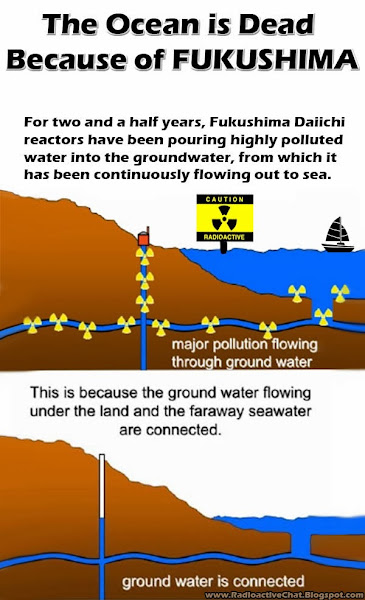
So far 314.700 Tons of Radioactive Reactor Water have been flowing into the Pacific Ocean and it continues to do so and have been doing so from the start 1049 days ago at an amount of 400 tons daily.

Ocean is dead because of Fukushima

The simulations, scientific studies shown to the public have NOT taken this into the calculations to date! There have now been 314.700 Tons more radiation flowing into the Pacific Ocean and that number is missing in all studies and simulations.


Share Buttons

☢ The Radioactive Chat ☢


Here you can chat live and stay updated with others about the events taking place. Share with friends and bookmark www.RadioactiveChat.Blogspot.com!

Geiger Counters - Radiation Detection Meters - Handheld Radiation Detector


When it comes to radiation detection meters you really have a wide field of gadgets to choose from, however radiation detectors are the most common to use. First of all if you need to know what type of radiation you are looking for. There are Alpha, Beta and Gamma radiation detectors. And also there is neutron emission of nuclear radiation. And all these different types of emissions have radiation detectors for a specific type of radiation that you can buy radiation detector for. Some also measure both Alpha and Beta. Others detect Alpha, Beta and Gamma. While others let you measure Beta and Gamma radiation.


What most people have use for though are Dosimeters you can buy a handheld radiation detector pretty cheap that are good addition to a survival kit. There are different kinds that you can use that will detect radiation. There are radiation badges that will tell you when radiation become high. Workers at nuclear power plants use these to inform them of how much radiation they have been exposed to. Now also children in the Fukushima prefecture have each been given a radiation badge so they know if they are exposed to radiation. Some come in the shape of a pen that you can carry in your pocket while other are made more compact so that you can attach them to your keychain. And then you have what is called a personal radiation monitor. These are also called Dosimeters and also normally called Geiger counters. Although not all use the Geiger-Muller Tube for the radiation detection some use a semiconductor instead. These and mostly the older geiger counters seen are pretty big to carry around, so they might not be best suited for a survival situation where you only need to carry the most important things. However if you have land and want to check radiation around the property and drinking water then these are the geiger counters to get because they are very well built units.

These are the once that you normally see people use. They have different units of radiation detection, because when it comes to radiation there are many standards used. some give the measurements in Rads, while other use Sieverts. Some have the maximum radiation value for the measured radioactivity quite low but they will still give you an idea of the amount of radiation in the area. With the units ranging from between background radiation 0.001 mSv/hr all the way up to 10 Sv/h. Normally a dosimeter will measure radiation in micro siverts per hour. If you were to walk into one of the reactor units at the Fukushima Daiichi Nuclear Plant you probably would get an error reading from your dosimeter because the radiation levels are so high there.

Note that some places outside the exclusion zone in Fukushima that are too radioactive for people to live in have areas where the radiation levels are above 30 Sv/h. So if you are in a area that have high radiation the radiation detectors would also there go off the scale. However Geiger counters or radiation detectors are still favored as general purpose alpha/beta/gamma portable radiation detectors and radiation detection equipment, due to their low cost and robustness. Most come with an LCD Display that show you the radioactivity in the area. Nowdays you will even get alarm sound and the possibility to connect the device to a computer. Either with a Infrared, Bluetooth or USB connection.

So if you look at the radiation detectors for sale that have this, then these radiation detection meters will allow you to make maps of contaminated areas that show where the radiation is high and low. This also will help you to see which areas are becoming more contaminated over time. With several nuclear reactors in the US and around the world located near fault zones that makes it a danger if a big earthquake would hit the area there is always a good choice to have a radiation dosimeter avaliable. I'm sure many in Fukushima would have been grateful to have dosimeters avaliable at the time of the disaster and I am sure you to would be grateful to have a geiger counter handy when you need one.

Fukushima

Categories